Showing posts with label American River. Show all posts

Thursday, May 13, 2010

Movable Bridges - Jibboom Street Bridge (2)

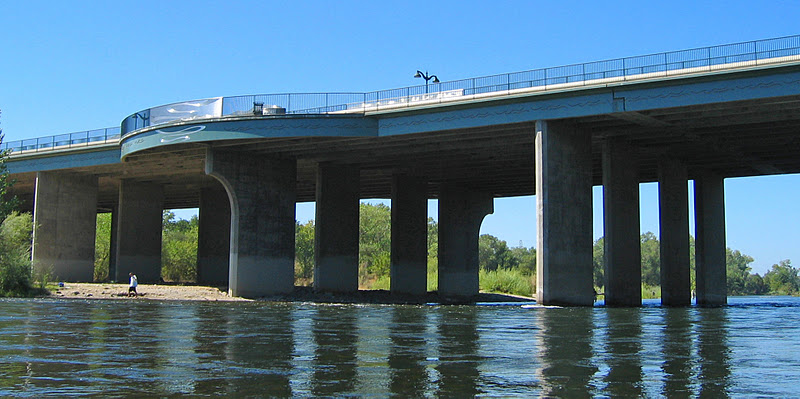
The American River empties into the Sacramento River just west of the Jibboom Street Bridge. There are many other rivers in Northern California that flow out of the Sierra Nevada Mountains into the Sacramento River. However, since much of the American River is whitewater rapids it's hard to understand why a movable bridge crosses it. Perhaps that's why the swing mechanism hasn't worked in many years. The bridge sits on a huge, cylindrical pivot pier and the two ends rest on piers that also support Parker truss spans. As I mentioned before, swing bridges are hardly ever built and are slowly being removed from waterways. The big exception is the previously studied Spokane Street Bridge in Seattle (shown on the April 29th and 30th blogs), which is huge, with the piers built outside the channel, and has won several design awards.
Creative Commons License
Movable Bridges - Jibboom Street Bridge (2)by Mark Yashinsky is licensed under a Creative Commons Attribution-NonCommercial-ShareAlike 3.0 United States License.

Friday, November 6, 2009

American River Bridges: Jibboom Street (Richard's Blvd) Bridge

Over the last few weeks we've looked at every bridge crossing the American River between it's confluence with the North and Middle Forks (in the Sierra Foothills) to its confluence with the Sacramento River (at the Jibboom Street Bridge). You can see the Sacramento River just beyond the bridge (in the photo) where all the speedboats congregate.

Many of the rivers coming out of the northern Sierra Mountain Range empty into the Sacramento as it flows south from Mt Shasta (for 450 miles) to Suisun Bay. Perhaps I can provide photos of all the bridges crossing the Sacramento River after I photograph a few of the bridges I'm still missing.

According to Historic Highway Bridges of California (published by Caltrans in 1990), the Jibboom Street Bridge is a cantilever swing bridge. The main span is a 351 ft long swing through span (on the left). The side spans are through Parker trusses. The bridge was built in 1931.

The swing span hasn't worked in many years, which is just as well since large vessels shouldn't be going up or down the American River. Its far too shallow and there are too many rapids. I wonder where the name Jibboom came from? It sounds like somebody's last name. Maybe a business person from the days of the Gold Rush.

I mentioned a few days ago that cyclists are encouraged to take the SNRR Bridge across the American River during the winter because the Jibboom Street Bridge can be under water due to flooding. Perhaps the swing span no longer works because the bridge is periodically under water? I remember flooding damaged the swing and lift mechanisms on most of the movable bridges along the Gulf Coast after Hurricane Katrina.
Creative Commons License
American River Bridges: Jibboom Street (Richard's Blvd) Bridge by Mark Yashinsky is licensed under a Creative Commons Attribution-NonCommercial-ShareAlike 3.0 United States License.

Thursday, November 5, 2009

American River Bridges: I-5 Expressway Bridges

It's a mile and a half downstream from 12th Street to the next two bridges across the American River. The I-5 Expressway Bridges are a pair of 28-span, continuous concrete box girder superstructures supported on pier walls. Each bridge carries five vehicle lanes. They were built in 1968, which seems to be when most of the highway construction was going on in Sacramento.

Note the architectural treatment at the ends of the piers, the vertical exterior girder, and the rather monolithic appearance of these bridges. That must be the modern, streamlined appearance of late 1960s bridge design in California.

Besides the occasional kayak, you don't see a lot of boats on the American River. Just downstream (near the confluence with the Sacramento River) the speed limit restriction is lifted, the water is much deeper, and the river is filled with jet-skis, motorboats, and big yachts.
Creative Commons License
American River Bridges: I-5 Expressway Bridges by Mark Yashinsky is licensed under a Creative Commons Attribution-NonCommercial-ShareAlike 3.0 United States License.

Wednesday, November 4, 2009

American River Bridges: 12th Street Bridge (2)

Another view of the 12th Street Bridge. There was a guy under the bridge working on a bike (on the closest pier foundation). Light rail trains roll by every 20 minutes along the east side of the bridge. The nearby Sacramento Northern Railroad Bridge used to carry electric trains many years ago, but now it carries cyclists.

It's hard to take a bad photo of this bridge. Standing on the north embankment provides a nice view of the four-banded barrier rail and the pedestals supporting electric power for the train.

Like the nearby 16th Street Bridge, this structure is a city street on the south side and becomes an expressway (State Route 160) on the north side of the bridge. It touches ground briefly north of the American River before becoming a 14 span viaduct over streets, Union Pacific tracks, bike trails, parkland, etc.
Creative Commons License
American River Bridges: 12th Street Bridge (2) by Mark Yashinsky is licensed under a Creative Commons Attribution-NonCommercial-ShareAlike 3.0 United States License.

Tuesday, November 3, 2009

American River Bridges: 12th Street Bridge

I like this bridge so much, that I'm going to provide another view of it (at deck-level) tomorrow. When I showed it to the head of Caltrans' Office of Aesthetics, he expressed surprise that it was in Sacramento. It has a timeless quality, like some architectural detail that has been repeated with subtle changes throughout time.

I like how the piers look like they are splitting by a mitosis-like process (the bridge was widened from two to four lanes in 1934) and I like the rounded cutwaters that become concave on top to support power poles.

The 12th Street Bridge is a five-span, closed spandrel reinforced concrete deck arch bridge.  It was built in 1915 but it has a modern look, as if some far-sighted architect or engineer had seen something by Frank Lloyd Wright and intuited the works of Corbusier. All of the shapes have moved beyond the purely geometric to something organic or anthropomorphic.
Creative Commons License
American River Bridges: 12th Street Bridge by Mark Yashinsky is licensed under a Creative Commons Attribution-NonCommercial-ShareAlike 3.0 United States License.

Monday, November 2, 2009

American River Bridges: 16th Street Bridge

I spent some time trying to decide what to call this bridge. Caltrans named it the American River Bridge, but that's what they call every bridge over the American River. Its just where 16th Street becomes the right side of State Route 160 near downtown Sacramento and so I felt the 16th Street Bridge would be most descriptive. I also thought about providing the latitude and longitude for this bridge. Perhaps I can provide some header information about each bridge including the latitude and longitude?

You can see the two truss bridges we recently studied about 200 meters upstream. The 16th Street Bridge is a six-span, continuous reinforced concrete box girder bridge on very thin, wide pier walls. It was built in 1968 and carries three lanes of traffic northeast over the American River.

You can see the variation of water levels by the water stains on the pier walls. We are approaching where the American River ends at the Sacramento River. It is the confluence of these two rivers that is so often a source of flooding in downtown Sacramento. The last big flood was in 1986 and a lot of time, money and energy since then has been spent on strengthening the levees along these two rivers.
Creative Commons License
American River Bridges: 16th Street Bridge by Mark Yashinsky is licensed under a Creative Commons Attribution-NonCommercial-ShareAlike 3.0 United States License.

Sunday, November 1, 2009

American River Bridges: Sacramento Northern Railroad Bridge

Just 150 meters downstream from the Western Pacific Railroad Bridge is the Sacramento Northern Railroad (SNRR) Bridge. This iron truss bridge was built at the turn of the last century. It was used by both the SNRR and by the Northern Electric Railroad.

About ten years ago, the track and ballast were removed and this railroad bridge was converted for bicycle use. In fact, the SNRR right-of-way north of the bridge was converted to a bike trail.

The area downstream can become flooded during the winter and cyclists are encouraged to take this bridge into downtown Sacramento rather than Jibboom Street Bridge which may be under water.

Note that the pier foundations are exposed and surrounded with cobbles due the gradual scouring of the river bottom.
Creative Commons License
American River Bridges: Sacramento Northern Railroad Bridge by Mark Yashinsky is licensed under a Creative Commons Attribution-NonCommercial-ShareAlike 3.0 United States License.

Saturday, October 31, 2009

American River Bridges: Western Pacific Railroad Bridge

Although it's hard to tell from this photo, we are approaching downtown Sacramento on our trip down the American River. I took many of these photos from my kayak, which was difficult as the boat tended to rotate whenever I put down my paddle.

The Western Pacific Railroad Bridge is a three span, steel through truss structure supported on pier walls and seat-type abutments. Although the bridge crosses the river at a high skew, the piers were built perpendicular to the bridge (rather than parallel to the river) and so the designer didn't have to adjust the ends of the truss spans to match the skew. On the north end of the bridge is a short, timber trestle section that allows bicyclists to go under the two sets of railway tracks carried on the bridge. The pier foundations are clearly visible, even at high tide above the river's surface. When the bridge was built (at the beginning of the 20th century) the riverbed was much higher then it is now and the resulting lower river leaves the pier foundations exposed.

The Western Pacific Railroad was formed in 1903 to build a standard gauge track connection to the Pacific. The company was acquired by the Union Pacific Corporation in 1983.
Creative Commons License
American River Bridges: Western Pacific Railroad Bridge by Mark Yashinsky is licensed under a Creative Commons Attribution-NonCommercial-ShareAlike 3.0 United States License.

Thursday, October 29, 2009

American River Bridges: Union Pacific Bridge (2)

This timber trestle acted as an approach structure for the steel truss railroad bridge over the American River we saw yesterday. I have often wondered whether an embankment or a bridge makes a less expensive approach for a river crossing. At this location however, a bike trail had to pass under the railroad tracks.

This timber trestle structure must be as cheap a bridge as it's possible to build. Lateral (and longitudinal) stability is provided by a pair of diagonal braces. The axial members are slightly battered to provide a little more stability. The axial members are anchored to the top and bottom beams by metal plates with narrow rims. Still, it must have been a remarkably strong structure to carry the dozens of freight and passenger trains that rumbled over it every day.

I wasn't aware of the difference between timber preserved with resin from the creosote bush and timber preserved with resin made from petroleum products, until I did some research for this article. It must have petroleum-based creosote that made this timber structure so combustible. Someone set fire to the bridge and it made a tremendous blaze with a dense cloud of smoke that could be seen from 50 miles away. In hindsight, an embankment supported by retaining walls seems like a cheaper investment, but Union Pacific replaced this structure with a steel trestle bridge in less than two weeks. We'll look at this new structure tomorrow.
Creative Commons License
American River Bridges: Union Pacific Bridge (2) by Mark Yashinsky is licensed under a Creative Commons Attribution-NonCommercial-ShareAlike 3.0 United States License.

Tuesday, October 27, 2009

American River Bridges: Business 80 Expressway Bridge

About two miles further downstream is the Business 80 Bridge. It's an eight-span steel plate girder bridge on oddly-shaped two column bents. The tops of the columns have pedestals that support the girders. The bridge was built in 1954 and renovated (and seismically retrofitted) in 1996.

This is a very busy bridge and expressway, and it's usually stop and go during rush hour. Its also quite noisy and you can hear the traffic from a mile away. I think steel plate girders must be noisier than concrete box girders.
Creative Commons License
American River Bridges: Business 80 Expressway Bridge by Mark Yashinsky is licensed under a Creative Commons Attribution-NonCommercial-ShareAlike 3.0 United States License.

Sunday, October 25, 2009

American River Bridges: Guy West Pedestrian Bridge

Less than a mile downstream from the Howe Avenue Bridges is the Guy West Pedestrian Bridge across the American River. This is the main pedestrian entrance into California State University in Sacramento. The bridge was named after Guy West, who was the founding president (in 1947) of what was then Sacramento State College.

The bridge is said to have been designed to have the same relative dimensions as the Golden Gate Bridge, which has a span of 6500 ft. That makes this bridge about 1/10 the size of the Golden Gate Bridge.

the Guy West Bridge was built in 1966 at a cost of $636,000. It's owned by the University who has been trying to give it to the city or the state since it doesn't have the resources to maintain it and it needs to be repainted, which will cost millions of dollars.
Creative Commons License
American River Bridges: Guy West Pedestrian Bridge by Mark Yashinsky is licensed under a Creative Commons Attribution-NonCommercial-ShareAlike 3.0 United States License.

Saturday, October 24, 2009

American River Bridges: Howe Avenue Bridges

Just a couple miles further downstream are the Howe Avenue Bridges. Each bridge is an eleven span, reinforced concrete box girder bridge carrying two traffic lanes and a sidewalk. This is the most popular kind of bridge built in California and the industry is very competitive for cast-in-place construction. The bridges are supported on tall, thin pier walls and they were built in 1969 and never widened or seismically retrofitted.
Creative Commons License
American River Bridges: Howe Avenue Bridges by Mark Yashinsky is licensed under a Creative Commons Attribution-NonCommercial-ShareAlike 3.0 United States License.

Friday, October 23, 2009

American River Bridges: Watt Avenue Bridge

When I do kayak through the rapids downstream of the Harold M Richey Memorial Bridge, it takes over an hour to get to the next bridge which is about four miles further down the American River.

The Watt Avenue Bridge is a thirteen span, continuous, reinforced concrete T-beam structure supported on pier walls. It was built in 1961 and widened to eight lanes in 2002. The widening included better accommodations for bicyclists and large balconies for people to congregate and look down at the river. It even has a water motif that was embossed and painted on the bridge.

It seems to me that the current is quite strong, and I have to slow down the kayak and aim for the bank or get swept downstream. You may also notice that there are no boats on the river. There is a speed limit of only a few knots and the river gets shallow and so most of the boats are further downstream.
Creative Commons License
American River Bridges: Watt Avenue Bridge by Mark Yashinsky is licensed under a Creative Commons Attribution-NonCommercial-ShareAlike 3.0 United States License.

Thursday, October 22, 2009

American River Bridges: Harold M. Richey Memorial Bridge


There's a park with river access near my house. I like to wheel my kayak to the park and kayak up and down the American River. However, I must remember to turn around under this bridge or else I'll be pulled into the rapids downstream and I won't be able to paddle back upstream. Kayaking on the river is strange because there are enormous rocks in the water that suddenly come almost to the surface and give me a sharp attack of vertigo.

This bridge's columns have that nice texture that they glue onto the concrete forms before they pour the concrete. The column's style seems very 1960's to me, but I don't have any information about when it was built. I do know that it is a six span, reinforced concrete box girder bridge on single column bents and its about 1000 ft long. Like yesterday's Fair Oaks Bridge, the Harold Richey Bridge is owned by the Sacramento County Parks and Recreation Department.

This bridge is usually crowded with families and cyclists, especially on the weekends. There are elaborate rules on the bridge deck about the right-of-way for pedestrians, equestrians, cyclists, etc. that I've never quite figured out. The bridge is named after Harold M. Richey and it was dedicated to him in 1987. I think that Richey was a county commission who was a strong supporter of the bike trail, and the bridge was dedicated to him after he died.

Creative Commons License
American River Bridges: Harold M. Richey Memorial Bridge by Mark Yashinsky is licensed under a Creative Commons Attribution-NonCommercial-ShareAlike 3.0 United States License.

Tuesday, October 20, 2009

American River Bridges: Hazel Avenue Bridge

This is actually called the American River Bridge but to avoid confusion with the many other bridges with the same name, I'm renaming it after the road that it carries.

Continuing the themes of the tremendous demand that growing communities place on more highway capacity, we can see the Hazel Avenue Bridge is getting widened. The bridge is just downstream from the Nimbus Dam and about four miles downstream from the Lake Natoma Crossing (and three miles upstream from the Sunrise Blvd Crossing). Moreover, this is where the American River Bike Trail (a much used recreational and alternative commuter resource) crosses the river. The widening will increase the capacity of the road and provide better safety for cyclists.

The existing bridge is a four span reinforced concrete box girder structure on single column piers built in 1966 (see below).  The widening will increase the deck from four to six lanes and support it on two column piers. The widening will also provide little bastions for cyclists and pedestrians to move off the traveled way and enjoy the view.

Creative Commons License
American River Bridges: Hazel Avenue Bridge by Mark Yashinsky is licensed under a Creative Commons Attribution-NonCommercial-ShareAlike 3.0 United States License.

Monday, October 19, 2009

American River Bridges: Historic Truss, Rainbow, and Lake Natoma Bridges

I thought we'd take one last look at the three American River/Lake Natoma Crossings in the City of Folsom.

These bridges reflect the pride and wealth of a community that can build new bridges while maintaining and even restoring bridges that reflect Folsom's past. It also reflects a willingness on the part of the community to solve problems and make compromises for the greater good.

I live about ten miles downstream where there are few bridges and I have to drive several miles to get across the American River. At one time, they discussed building a bridge very close to my house but I'm glad the plan fell through. I wouldn't want all the cars and noise in my little neighborhood.
Creative Commons License
American River Bridges: Historic Truss, Rainbow, and Lake Natoma Bridges by Mark Yashinsky is licensed under a Creative Commons Attribution-NonCommercial-ShareAlike 3.0 United States License.

Sunday, October 18, 2009

American River Bridges: Lake Natoma Crossing

Because of all the traffic problems on the Rainbow Bridge, the City of Folsom built the Lake Natoma Crossing just downstream in 1999. It is a 2300 ft long prestressed concrete box girder bridge. It includes three 328 ft long haunched girder spans over Lake Natoma, which was formed by Nimbus Dam just downstream from Folsom Dam. It provides four vehicle lanes, two bike lanes, and pedestrian walkways, and takes some of the traffic off the Rainbow Bridge.

There are several interesting features on this bridge. For one thing it was designed with a lot of community input, which included the appearance of the bridge. There are a lot of embellishments reflecting the City of Folsom's 19th century appearance (brackets supporting the bridge overhangs and Victorian bridge columns). However, the most controversial element is the decorative arches that serve no purpose except to resemble the arch on the Rainbow Bridge just upstream. To me this is intellectually dishonest and gives the bridge an overdecorated appearance. Apparently HDR (the designers) couldn't get a real arch bridge to work with the seismic and other restraints and offered this as a solution. It does match the overdecorated style of the Victorian era, although the parabolic shape seems more modern.

The other interesting feature is the seismic design. The columns are supported on large-diameter pile shafts embedded into rock. The top of the columns have isolation bearings that allow the superstructure to move during an earthquake without putting large demands on the columns. Moreover, the superstructure was made with lightweight concrete to reduce the inertial force to the bearings.

The bridge reflects the needs of the community and the various compromises that had to be made between the demands of nature and society. However, I don't think that Ayn Rand/ Howard Roark would approve.
Creative Commons License
American River Bridges: Lake Natoma Crossing by Mark Yashinsky is licensed under a Creative Commons Attribution-NonCommercial-ShareAlike 3.0 United States License.

Saturday, October 17, 2009

American River Bridges: Folsom Rainbow Bridge

Just downstream from the Historic Folsom Truss Bridge is the Rainbow Bridge, which carries Greenback Lane over the American River. For many years, this was the only bridge across the American River, which must have been a real hassle in such a highly populated area. Even today, it has too much traffic on an antiquated structure that needs to be replaced.

The Rainbow Bridge was built in 1917 and was widened from 23.33 ft to 31.0 ft in 1969. It has a 209 ft long open spandrel arch span over the river, seven T-girder approach spans to the north of the river and four T-girder approach to the south of the river for a total length of 511 ft.

The bridge only has one lane of traffic in each direction, narrow shoulders, and a 4 ft sidewalk but it carries about 38,000 vehicles a day. Also, the bridge is eligible to be on the list of Historic Places. The city of Folsom will have to make some hard choices whether they should keep this historic structure or replace it with a new, wider bridge.
Creative Commons License
American River Bridges: Folsom Rainbow Bridge by Mark Yashinsky is licensed under a Creative Commons Attribution-NonCommercial-ShareAlike 3.0 United States License.

Friday, October 16, 2009

American River Bridges: Historic Folsom Truss Bridge

A couple of miles downstream from Folsom Dam are three bridges clustered together across the American River. The first bridge is a truss structure that replaced a suspension bridge at this site in 1893. However, it wasn't built to handle automobiles and it was closed after another bridge was built alongside of it. It was eventually moved to Northern California where it was used to cross the Klamath River. In the 1990's, it was brought back to Folsom, renovated, set back on it's original foundations, and used as a pedestrian and bicycle bridge across the American River.

My first impression was that this bridge was very tall. It has about a 330 ft span and it's about 30 ft tall, so maybe this kind of truss requires a 1 to 10 ratio between its depth and its span. I would guess that its a Pratt Truss with all the diagonals in tension, but I'm not an expert on truss bridges. If you know what type of truss this is, please let us know.

Truss bridges must have seemed the height of scientific progress in the 19th century, but now they are seldom used. Before computers, it was relatively easy to determine the forces on these structures that have no flexural members, just compression and tension members with pinned connections. They still seem to be a very efficient method of spanning long distances with a minimum of steel. Maybe some innovation in truss bridge design will bring them back into fashion or maybe they'll eventually disappear.
Creative Commons License
American River Bridges: Folsom Historic Truss Bridge by Mark Yashinsky is licensed under a Creative Commons Attribution-NonCommercial-ShareAlike 3.0 United States License.

Thursday, October 15, 2009

American River Bridges: Folsom Dam Bridge


We must travel about sixteen miles downstream from the No Hands Bridge along the American River and past Folsom Lake to reach the next bridge, which was just completed a few months ago. The Folsom Dam Bridge was built because Homeland Security didn't want the public to drive on large dams after 9/11.

A friend just sent me some photos of a new bridge they're building across the Colorado River so that no one drives over the Hoover Dam. Similarly, after 9/11, people were prevented from driving over Folsom Dam, creating a traffic nightmare, that was eventually solved when the Folsom Dam Bridge was build a few hundred yards downstream.

I'm in no position to judge how serious a threat terrorists blowing up a dam is to U.S. security. I know that after 9/11, people came up to me occasionally and asked me why I was photographing a bridge, as if I was planning to blow it up! I thought that was being a little paranoid, but I'm probably in the minority. Anyway, more bridges means more work for bridge engineers!

I photographed this bridge (without a tripod) using auto-bracketing to create three images that were merged together in Photoshop to create a high-density-range (HDR) photo. However, I think the color looks a little strange. I rode my bike seventeen miles from my house along the American River Bike Trail to the bridge last Saturday. I was surprised by the razor wire on top of the fence (that ruined the photograph) but that's a small price to pay to be secure I guess.

As you can see, its a continuous, three-span, prestressed concrete box girder bridge on squat columns that look like an unfortunate choice for earthquake country. Caltrans requires spirals or hoops for transverse reinforcement, but these columns look like they're built with stirrups and ties. Well, this isn't a highly seismic area, and the bridge had to be reviewed by Caltrans, so it's probably okay.

In the computer graphics used as public relations for the bridge they show hikers and cyclists along the bike trail without any fences or razor wire to obscure the view.
Creative Commons License
American River Bridges: Folsom Dam Bridge by Mark Yashinsky is licensed under a Creative Commons Attribution-NonCommercial-ShareAlike 3.0 United States License.